
Article: Why Women Over 50 Struggle to Find the "Perfect" Clothes (And Why Comfort Matters More Than You Think)

Why Women Over 50 Struggle to Find the "Perfect" Clothes (And Why Comfort Matters More Than You Think)
Why Women Over 50 Struggle to Find the "Perfect" Clothes (And Why Comfort Matters More Than You Think)
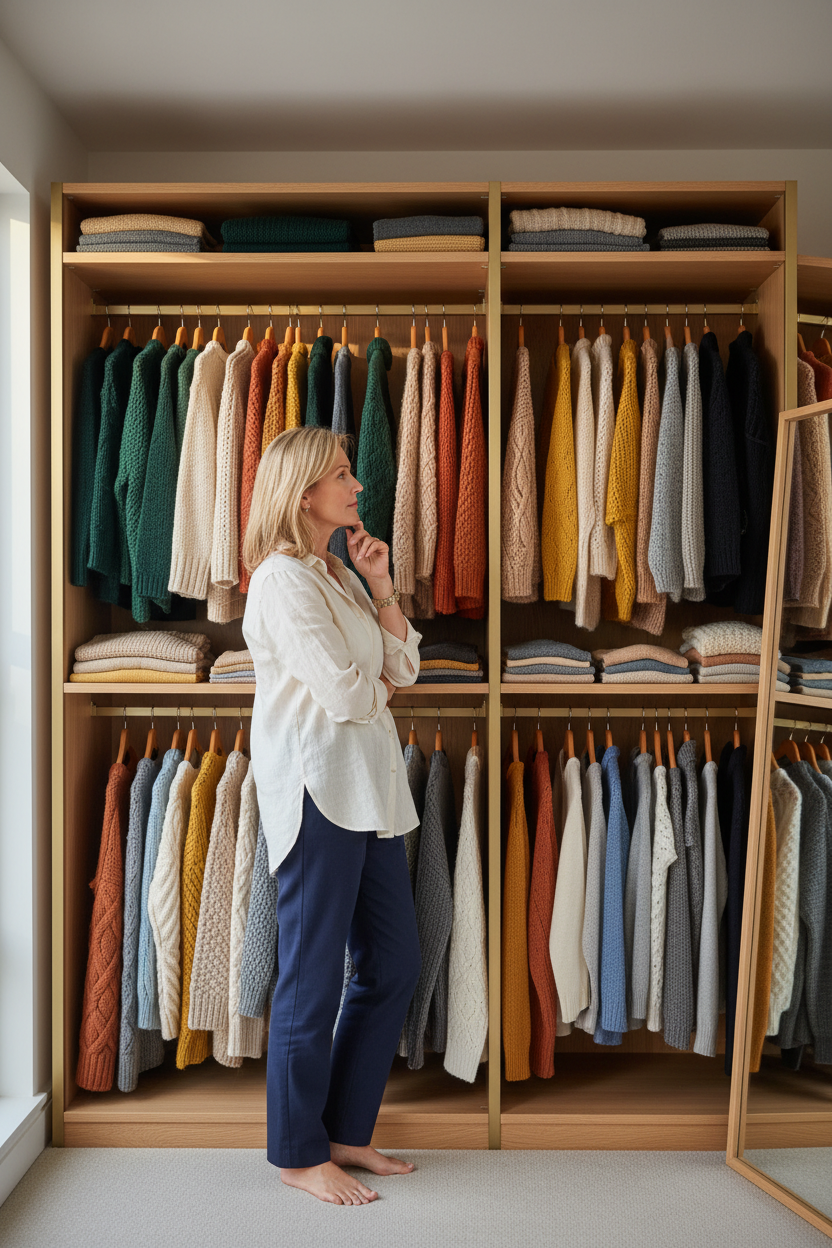
If you've stood in front of your closet lately, sighing at a rail full of clothes that somehow don't fit right anymore, you are far from alone. This isn't a personal failing, and it isn't about "letting yourself go." The truth is far more structural than that, and once you understand why, it gets a lot easier to shop smarter and dress for the body you actually have.
It's Not You. It's the Sizing System.
Most clothing sizing in use today traces back to research conducted in the 1940s and 50s, when a small, unrepresentative sample of women's bodies was used to build the size charts the industry still leans on. Even then, researchers found that roughly two-thirds of women fell outside the "standard" body shape being measured, and those women were simply left out of the model.
The consequences are still showing up in fitting rooms today. Recent research suggests that fewer than one in five women actually match the proportions that standard retail sizing assumes. And it's not just an older-generation problem: one industry study found that three-quarters of women over 35 experience moderate to severe fit issues when shopping, and roughly seven in ten said they wear a different size depending on the brand, even within similar styles of garment.
So if a "size 12" fit you five years ago and doesn't anymore, in some other brand's cut, the problem usually isn't your body. It's a system built on a shape that was never universal to begin with, and that becomes even more obvious as your body changes with age.
Why Your Body Genuinely Is Different Now, and That's Not a Bad Thing
Somewhere around 50, many women notice their favorite styles simply stop sitting the way they used to. There's a real, physiological reason for that.
Hormonal shifts around menopause tend to redistribute fat away from the hips and toward the midsection. At the same time, muscle mass naturally declines by roughly 1 to 1.5% a year from around this age onward. The result is a silhouette that's genuinely different from the one your wardrobe was built around in your 30s, not worse, just different.
This is exactly why so many women find something that fits beautifully through the hips but gaps at the waist, or fits the bust but billows everywhere else. It isn't a fitting room illusion. It's proportion, and standard sizing was never designed to flex with it.
Why This Isn't Just About Vanity
It would be easy to write all this off as a superficial complaint. The research says otherwise.
Psychologists have spent over a decade studying something called enclothed cognition, the idea that what we wear doesn't just reflect how we feel, it actively shapes it. Clothing that fits well and feels good has been shown to influence posture, confidence, and even how assertively people engage with the world around them. Clothing that doesn't, understandably, has the opposite effect.
More strikingly, a recent survey of women in midlife found that when they couldn't find clothing that made them feel confident and appropriate, they were more likely to withdraw from social situations altogether, which then made their mood worse. It's a cycle: feeling good in your clothes supports you showing up in your life, while feeling invisible or uncomfortable in them makes you want to retreat from it. Researchers involved in that study noted they were struck by just how overlooked these women felt. They wanted to spend on fashionable clothing but simply couldn't find suitable options.
That's a bigger deal than it sounds. Clothing satisfaction has been linked to overall wellbeing, not because fashion is frivolous, but because what you put on your body genuinely affects how you move through your day.
So What Actually Helps?
-
Stop blaming your body, start blaming the block. Most brands grade their sizes up and down from a single sample size without redesigning the cut for different proportions. If something doesn't fit, it's worth trying a different brand before assuming it's you.
-
Learn which brands are built for your shape, not just your size. Every label cuts differently. Once you find two or three that consistently work for your body, shopping gets dramatically easier.
-
Prioritize fit over size number. A comfortable, well-proportioned size 14 will always look better than a squeezed-into size 10. The number on the tag has never meant what we've been trained to think it means.
-
Don't underestimate a good tailor. A single alteration can turn a "close enough" piece into one that actually fits, and it's often far cheaper than replacing your whole wardrobe.
-
Choose comfort as a non-negotiable, not an afterthought. Comfort and style were never actually in competition. Clothes that move with your body, breathe well, and don't require constant adjusting are the ones you'll reach for and feel confident in, again and again.
The Real Takeaway
Struggling to find clothes that fit after 50 isn't a reflection of your body doing something wrong. It's the predictable result of an industry that built its sizing system around a narrow, decades-old idea of what a woman's body should look like, and never fully updated it as real bodies, and real women, kept changing.
Feeling comfortable in what you wear isn't a small thing. It's often the difference between a day you show up fully in and one you spend adjusting a waistband instead. You deserve clothes that were designed with your actual body in mind, not one you have to keep apologizing to.
%0AIf%20you've%20stood%20in%20front%20of%20your%20closet%20lately,%20sighing%20at%20a%20rail%20full%20of%20clothes%20that%20somehow...)